
Enterprises are deploying AI agents faster than they can account for them. Agents are running in production, spinning up subagents, calling APIs, and consuming compute at unprecedented rates. Agentic technology has far outpaced the infrastructure to understand what they cost and what they're worth.
Many organizations are operating without accountability or budget guardrails, and they can’t connect spend to business outcomes. Gartner predicts over 40% of agentic AI projects will be canceled by the end of 2027 due to escalating costs, unclear business value, and inadequate risk controls.
A new category of tools has emerged to address this, and vendors with various approaches are eager to position themselves as the solution. But not all of them solve the full problem. Some track token spend, but might not be able to connect AI activity to business outcomes. Others allocate cloud costs effectively but don’t monitor model performance.
In this post, we’ll compare 10 prominent AI cost management platforms based on the core capabilities that AI-powered organizations need to measure and control their spend effectively.
What Should an AI Cost Management Tool Actually Show You?
To make a fair comparison, we need a consistent set of criteria that reflects the full complexity of running AI agents in production, not just the token bill at the end of the month.
The five criteria below are drawn from The Financial Blind Spots in Autonomous AI, a framework for evaluating what genuine AI economic control requires at enterprise scale.
With these benchmarks in place, here's how 12 of the most prominent platforms in this space stack up.
How 10 AI Cost Management Tools Stack Up
The twelve platforms below span three categories: AI-native tools, cloud FinOps pivots, and observability platforms, each approaching AI cost management from a different starting point.
We'll evaluate each one against the five criteria above, covering what it does well, where it falls short, and how its origins shape what it can and can't do.
AI-Native Platforms
These platforms were built from the ground up for the economics of AI, not adapted from cloud cost management or observability tools. They vary significantly in scope, from broad economic control systems to narrow cost trackers, but AI agent spend is their primary design focus rather than an extension of the original software.
1. Revenium
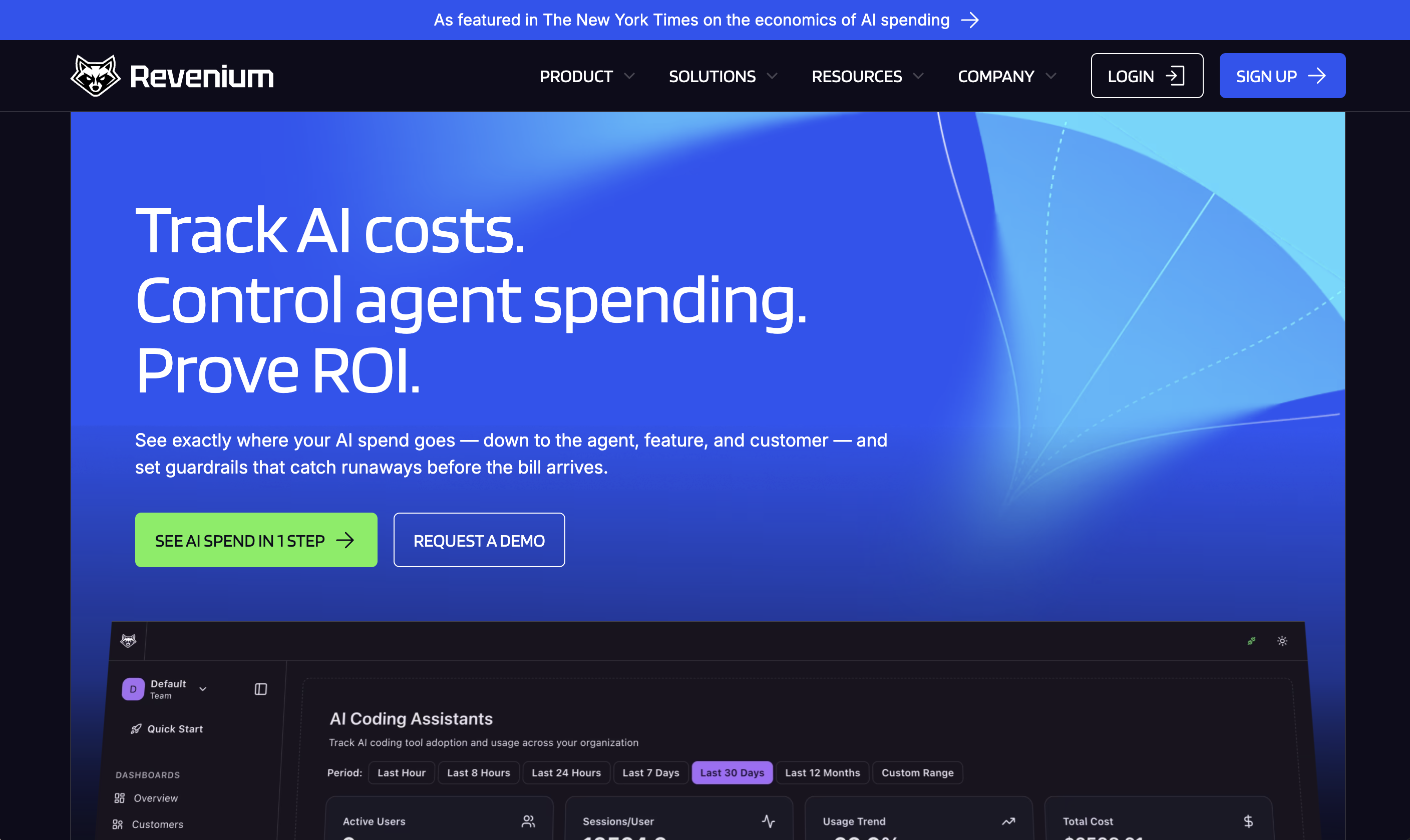
Revenium is built around a question most platforms in this space don't ask: Based on the ROI, should this agent action have happened at all?
Where observability tools report after the fact and FinOps tools allocate costs after the month ends, Revenium operates as an AI economic control platform, sitting in the execution path itself to evaluate, authorize, or deny agent spend before it occurs. Every outcome is then recorded in the financial systems that govern the rest of the business.
What it covers:
- A three-level identity model (Credential > Subscriber > Organization) associates each agent call with a specific user, workflow, and customer account. This ensures that every dollar spent has a clear owner.
- Every agent, model version, and tool is tracked in a central registry, so when something changes, the cost impact is visible immediately rather than showing up as an unexplained spike later.
- Beyond token spend, Revenium tracks the cost of every external tool call an agent makes (third-party APIs, data services, SaaS integrations, etc.), because those costs often exceed the model bill. That full picture is then mapped to business outcomes like revenue generated, support cases deflected, sales closed, and more.
- Spend limits are enforced before a call goes out, not after it returns. If a call would breach a budget rule, scoped by model, provider, customer, or any custom dimension, it's stopped before any cost is committed.
The combination of visibility, attribution, and real-time control in a single platform is what distinguishes Revenium from most other tools in this space.
2. Ascerta (Pay-i)

Ascerta (formerly Pay-i) connects AI spend to business outcomes, showing which initiatives deliver measurable ROI and which burn budget without results. Beyond token costs, Ascerta also offers a separate Provisioned Capacity Optimizer that tracks whether the GPU and reserved compute a team has pre-purchased are actually being used, which is a useful complement for organizations managing both token spend and infrastructure commitments.
What it covers:
- Connects AI spend to business outcomes at the use-case level, with cost and ROI reporting by initiative.
- Tracks the full cost of each use case beyond token pricing, including embeddings, caching, and execution overhead across multiple model providers.
- Lets teams test models, prompts, and architectures against each other on both cost and business results, not just technical performance.
- Budget limits can be set at the org, team, or agent level, with alerts, throttling, and hard stops enforced before a call goes out.
- Runs within the customer's own cloud environment, so data never leaves their infrastructure.
- Shows whether reserved GPU and capacity commitments are actually being used, with cost breakdowns by team, agent, and use case.
Where it falls short:
- Budget controls enforce pre-set spend limits, but don't evaluate whether a specific agent action is worth its cost before it executes. The platform stops overspend, but doesn't make a value judgment on individual calls.
- Agent activity isn't bound to specific users, workflows, and budgets at the individual transaction level.
- Doesn't track the cost of external tool calls as part of the total cost picture.
- AI spend doesn't feed directly into financial systems for settlement and audit.
Ascerta connects AI spend to business results rather than just reporting what was spent. But falls short on two fronts. It can enforce budget limits and shut down a use case when a threshold is crossed, but it doesn't evaluate whether an individual agent action is worth its cost before that action runs. And because it doesn't track the cost of external tool calls, the total cost picture is incomplete. Token spend is only part of what an agent workflow actually costs to run.
3. Payloop
Payloop is a lightweight cost-tracking tool built for engineering teams who want immediate visibility into the cost of their LLM calls. It installs quickly, tracks every call automatically, and gives engineering managers a clear view of who is spending what across their team.
What it covers:
- Tracks every LLM call by task, agent, and customer automatically via a one-line SDK installation.
- Shows spend by user, session, model, and error rate across the team, with individual drill-down.
- Surfaces margin visibility to help teams evaluate and test pricing models as usage grows.
- Includes a security layer that blocks prompt injection attacks, jailbreak attempts, and off-topic prompts.
- Lets teams compare model costs and simulate pricing before committing to a model.
Where it falls short:
- No mechanism to evaluate or stop a call before spend is committed. It tracks costs as they accumulate, but can't intervene before they occur.
- No tracking of which agents or model versions are running in the environment.
- Costs are tracked at the task and agent level, but not connected to business results.
- No connection to financial systems for settlement or audit.
Payloop gives engineering teams a fast, low-friction way to see what their LLM calls are costing, but it covers visibility only and stops well short of what enterprise AI cost control requires.
Cloud FinOps Pivots
These platforms have strong roots in cloud cost management and have expanded their scope to cover AI spending as the category has grown. Having spent years solving cloud cost allocation at enterprise scale, they offer mature engines, deep integrations, and established relationships with finance and infrastructure teams. Their AI cost capabilities are real, but they're extensions built onto that foundation rather than purpose-built for agent economics.
4. CloudZero
CloudZero is a cloud cost management platform that has spent nearly a decade helping enterprises track and allocate spending across cloud infrastructure, pulling billing data from AWS, Azure, GCP, and SaaS tools and attributing it to the teams, products, and customers responsible for it.
It recently expanded into AI economics, launching what it calls the Financial Control Plane for AI. Its core strength is attributing spend across cloud, AI, and SaaS to any business dimension (customer, product, feature, team, or model) and surfacing that data in real time rather than waiting for monthly billing exports.
What it covers:
- Automatically attributes all cloud, AI, and SaaS spend to the right team, product, feature, or customer, without requiring anyone to label or categorize costs manually.
- Captures AI spend in real time with anomaly detection that operates in seconds rather than daily billing exports.
- Surfaces cost intelligence directly inside AI coding tools via MCP, with pre-built analysis prompts for engineering and finance teams.
- Optimization recommendations that route directly to engineering teams via Jira and Slack.
Where it falls short:
- Despite its "financial control plane" positioning, the platform operates only as a visibility and attribution system. There is no mechanism to evaluate, stop, or reroute an agent action before spend is committed.
- Cost attribution works at the team and product levels, but not at the individual transaction level. There's no way to tie a specific agent action back to the exact user, workflow, or budget that triggered it in real time.
- AI spend does not feed into financial systems for settlement and audit.
CloudZero tells you what your AI spent and where it went, and does that very well. But financial intelligence and financial control are different capabilities. Knowing where spend went is not the same as being able to stop it before it occurs.
5. Finout
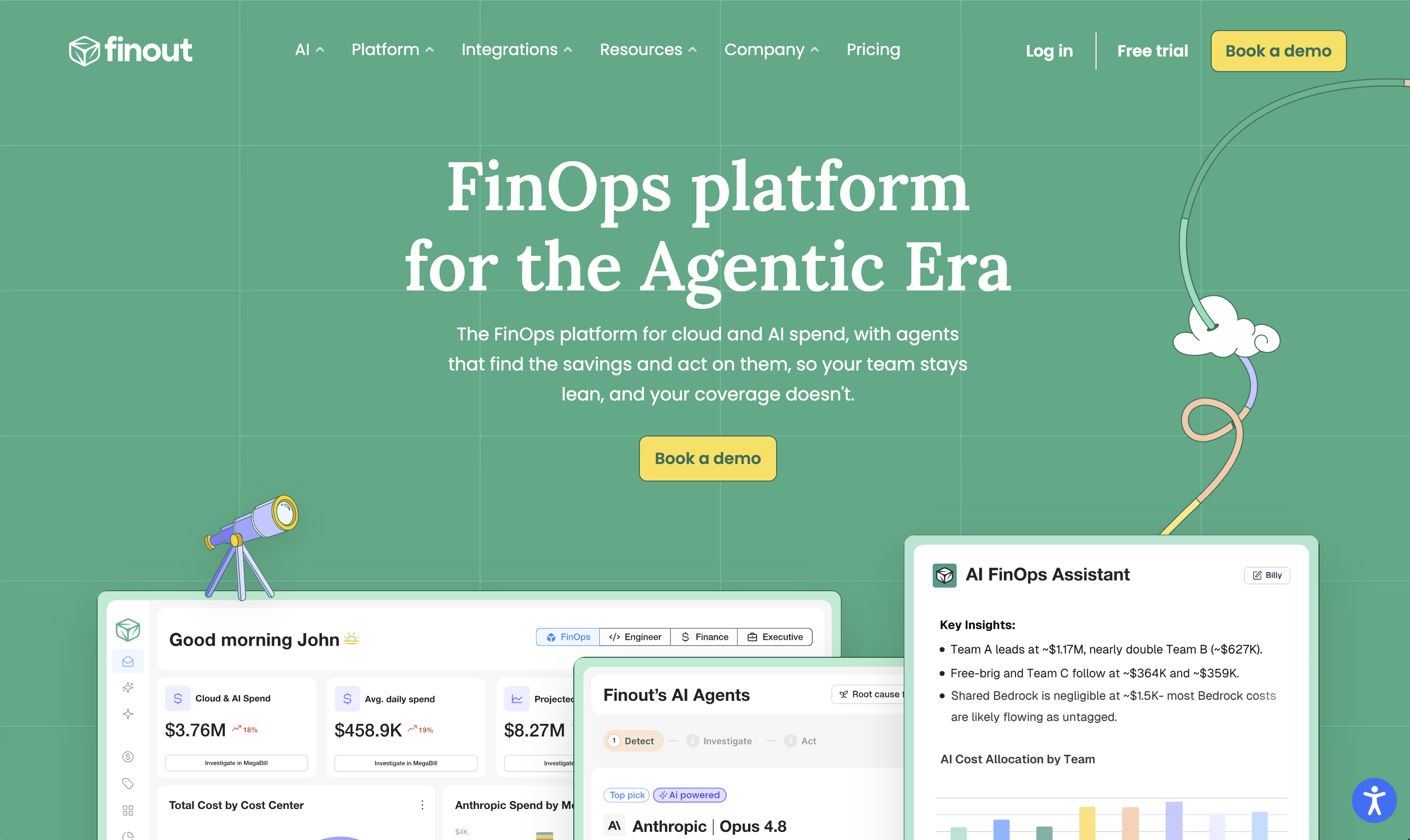
Finout is a FinOps platform that has expanded to cover AI spending. Its core strength is pulling spend from across cloud providers, SaaS tools, AI services, and Kubernetes into a single view. From there, it attributes that spend to the teams, products, and owners responsible for it. For organizations struggling to answer basic questions about where AI spend is going, it's a capable and well-integrated tool.
What it covers:
- Tracks what each model call costs across major providers, including OpenAI, Anthropic, and Cursor.
- Attributes cost per agent run by team and workflow.
- Anomaly detection and spend alerts flag spikes before they escalate.
- An MCP server lets teams query cost data in plain language from their own AI agents and workflows.
- Exports spend data to external financial and BI tools for reporting and forecasting.
Where it falls short:
- No way to intervene before spend occurs. Finout's AI layer investigates and explains what happened, but enforcement is handled by fixed budget thresholds. It can trigger an alert or block a call when a limit is hit, but it can't evaluate whether a specific agent action was worth its cost before it runs.
- Agent activity is not bound to specific users, workflows, and budgets at the individual transaction level.
Finout is a strong choice for FinOps teams that need visibility and allocation across a complex cloud and AI stack, but it was built to report on spend, not govern it in real time.
Cloud and Observability Platforms
These platforms were built for infrastructure monitoring: tracking what's running, how it's performing, and where things are breaking down in production systems. AI cost tracking has become a natural extension of that work, but their architecture is built around visibility and performance, not cost governance or economic control.
6. Datadog LLM Observability
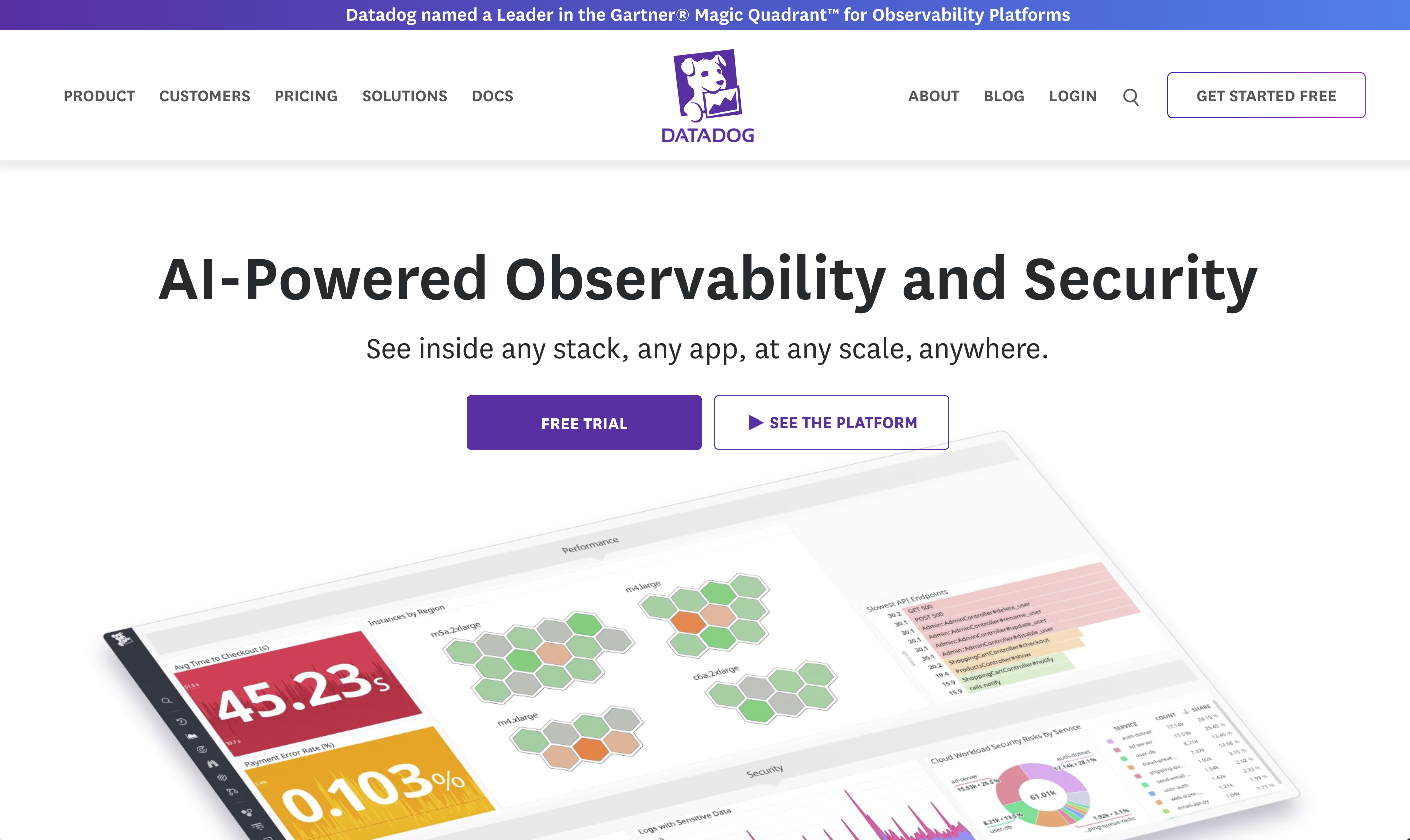
Datadog’s AI observability product brings enterprise-grade infrastructure to LLM monitoring, unifying tracing, evaluation, and production monitoring on a single platform. For engineering and SRE teams already running Datadog who want to bring AI agent behavior into the same workflow they use for everything else, it's a natural extension.
What it covers:
- Traces every LLM call end-to-end (prompts, tool calls, retrieval steps, and agent decisions) across all major model providers and frameworks.
- Tracks model quality in two ways: testing prompts and outputs in a controlled environment before they go live, and monitoring real production responses as they happen. Teams can flag and annotate responses for human review, build test datasets from actual production traffic, and run custom quality checks tailored to their use case.
- Monitors latency, token usage, error rates, and cost at every step of an agent workflow, with alerting and production dashboards.
- Connects agent behavior to the backend services, infrastructure, and real user sessions it touched. When something goes wrong, you can trace the full chain rather than investigating each system separately.
Where it falls short:
- Built for observability and performance monitoring, not economic control. It surfaces cost and quality data but does not stop or reroute agent spend before it occurs.
- No way to tie a specific agent action back to the exact user, workflow, or budget that triggered it.
- Cost tracking covers LLM token usage but not the full cost of a workflow, including external tool calls, retry loops, and human escalation time.
- AI spend does not feed into financial systems for settlement and audit.
Datadog is the right tool for teams that need enterprise-grade observability across a complex AI and infrastructure stack. But it gives visibility into what agents did, not control over what they're allowed to do. And because it tracks token costs rather than the full cost of a workflow, the picture it provides is incomplete.
7. Helicone
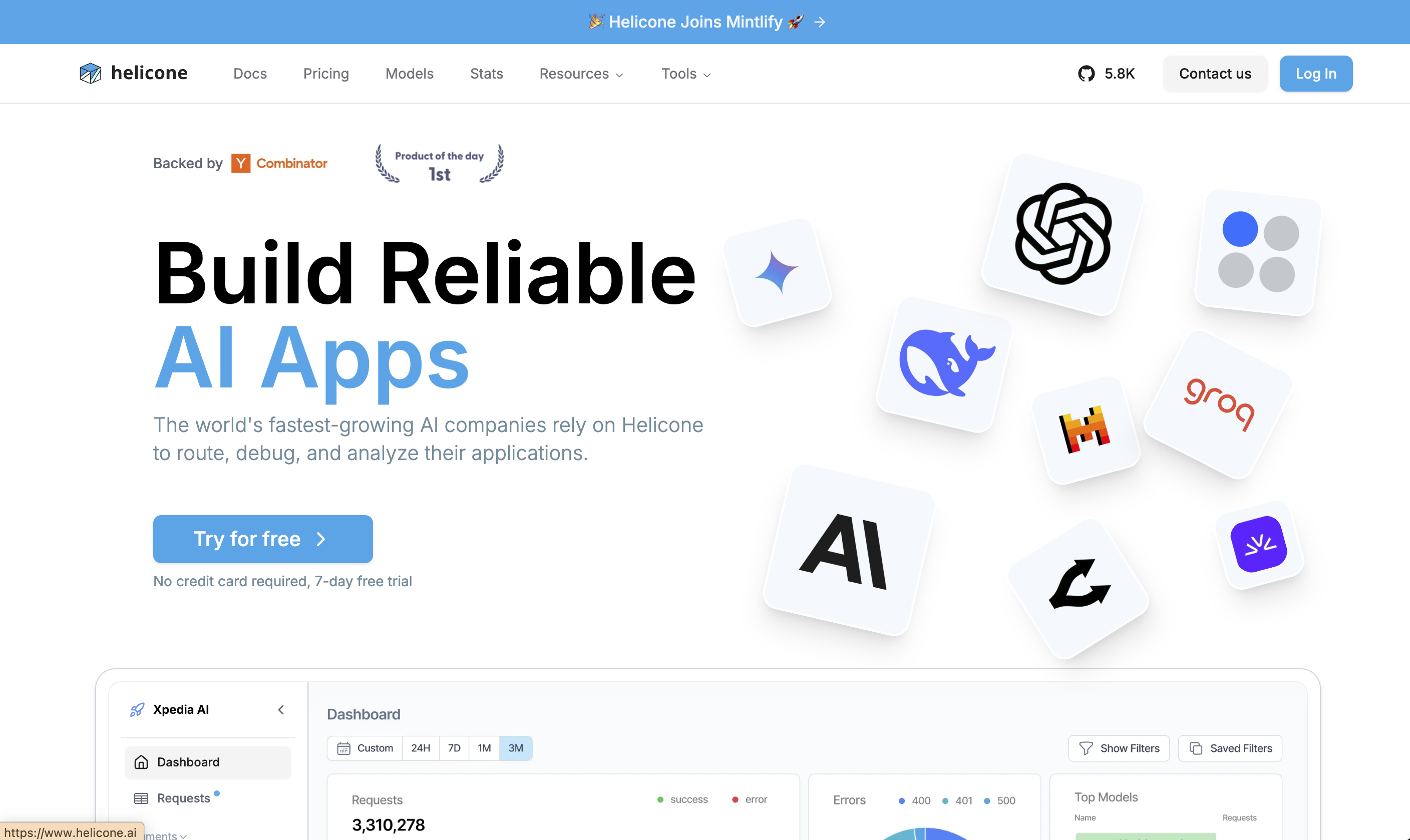
Helicone is an open-source LLM observability platform. Instead of requiring code changes throughout your application, Helicone redirects your existing API calls through its own servers. You change a single URL in your configuration, and from that point on, every LLM call is logged automatically.
What it covers:
- Logs every LLM request across 100+ models automatically via a proxy, with no instrumentation required.
- Tracks cost, latency, token usage, and error rates per request across providers.
- Rate limiting and alerts configurable per user, API key, or custom property.
- Tools for testing and refining prompts. Version history, test datasets built from real traffic, and a sandbox environment for experimenting before changes go to production.
- User and session-level segmentation for tracking spend and behavior by customer.
Where it falls short:
- The proxy logs and routes traffic, but does not evaluate whether an agent action is worth its cost before committing spend.
- Agent activity is not bound to specific users, workflows, and budgets at the transaction level.
- Cost is tracked at the request level but not connected to business outcomes.
- AI spend does not feed into financial systems for settlement and audit.
Helicone is a practical, low-friction starting point for teams that want immediate visibility into LLM usage across a broad model stack. Its proxy architecture is built for observability and routing, not economic control.
8. Vantage
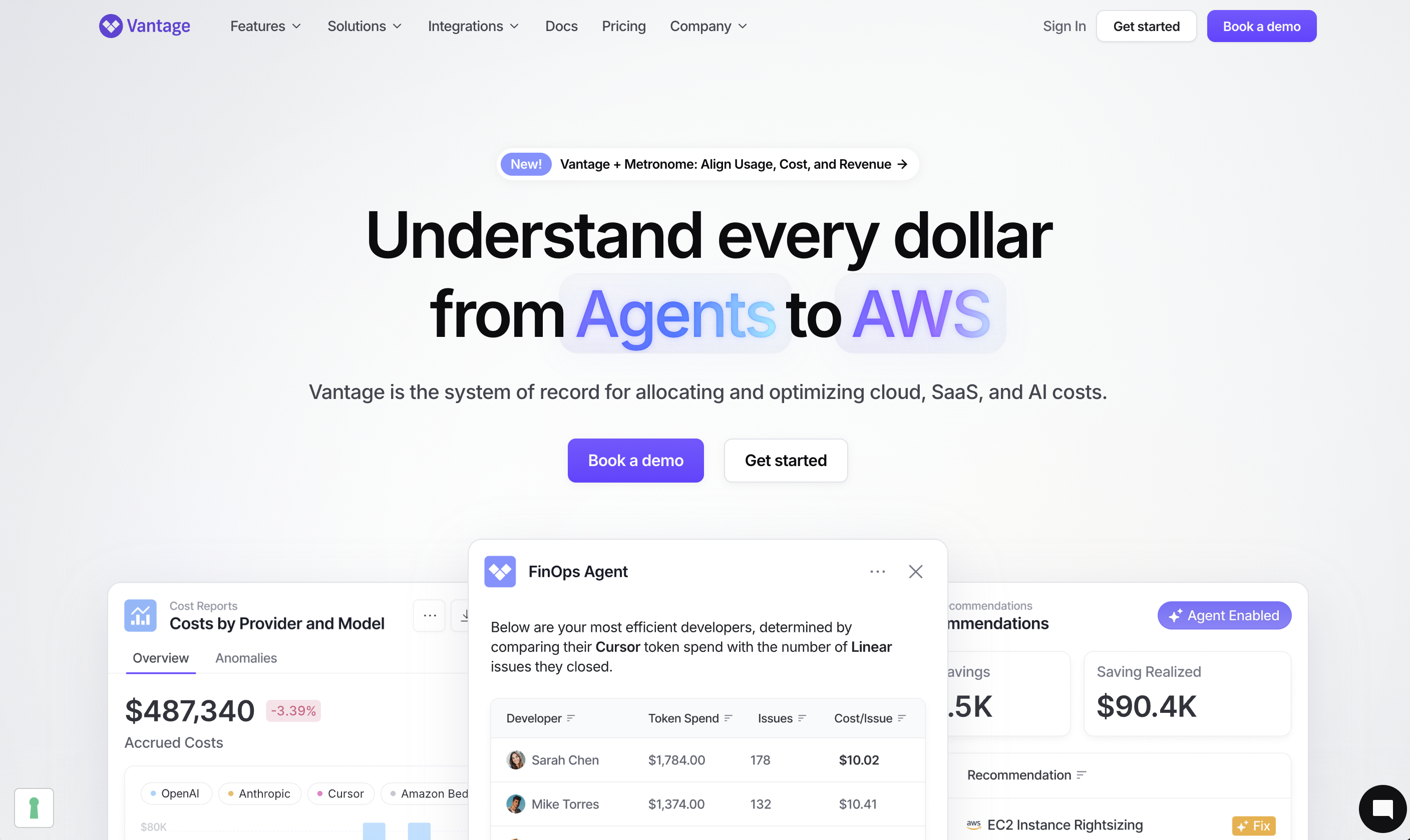
Vantage is a multi-cloud cost management platform. Its core strength is cloud cost visibility and optimization across AWS, Azure, and GCP. AI cost tracking is a growing part of the platform, but it sits alongside a broad infrastructure cost management suite rather than being built specifically for agent economics.
What it covers:
- AI model cost tracking across OpenAI and Anthropic, with tagging by model or team.
- GPU usage and Kubernetes efficiency metrics for AI infrastructure workloads.
- Anomaly detection, budget alerts, and automated waste detection across cloud and AI spend.
- A FinOps Agent that proactively identifies cloud waste, recommends remediation actions, and can execute them autonomously or with human approval, with a full audit log.
- An MCP server for cost queries in plain language inside Claude, Cursor, or ChatGPT.
Where it falls short:
- The FinOps Agent is scoped to cloud infrastructure waste, not AI agent spend governance.
- Cost visibility is at the infrastructure and model level, not the individual agent action or business outcome level.
- Agent activity is not bound to specific users, workflows, and budgets at the transaction level.
- No connection between AI spend and business outcomes.
- AI spend does not feed into financial systems for settlement and audit.
Vantage is a strong choice for organizations that need to bring AI infrastructure costs into a broader cloud cost management picture, but it was built to track and optimize spend after the fact, not to control what agents are authorized to do before they act.
9. LangSmith
LangSmith is LangChain's observability, evaluation, and tracing platform. It's the most widely-used LLM monitoring tool on the market today. Any team building agentic applications with LangChain, which is most of them, has at least tried it.
What it covers:
- Traces every LLM call, chain step, tool call, and agent action end-to-end, with full cost and latency tracking per run.
- Runs experiments and evaluations comparing model versions on both quality and cost before deploying to production.
- Tracks cost per project, per user, and per trace, not just aggregate token spend.
- Threads, feedback collection, and human-in-the-loop annotation for production monitoring.
- Dataset management for regression testing and prompt iteration.
Where it falls short:
- Built for observability and evaluation. It shows what agents cost and how they performed, but doesn't sit in the execution path to stop or reroute spend.
- Identity model (API key > project > user) is broad and doesn't bind spend to specific workflows, budgets, or customer accounts.
- No connection to ERP or financial systems for settlement.
- Heavily optimized for the LangChain ecosystem; teams on other frameworks get partial value.
LangSmith is the default choice for teams that built with LangChain, and it does observability and evaluation well. But like the other platforms in this category, it shows you what agents cost and how they performed without any mechanism to decide, in real time, whether they should spend at all.
DevOps and Delivery Platforms
Harness gets its own category here because it doesn't fit cleanly into the others on this list. It's a software delivery and CI/CD platform that has added cost and productivity features as AI tooling became part of the development lifecycle; a real capability, just not the one this piece is built around.
10. Harness
Harness is a software delivery platform that has built two products relevant to AI economics. Harness approaches AI cost from a different angle than the rest of this list, measuring whether AI coding tools are worth their spend, not governing agent actions in production. Its Cloud and AI Cost Management product covers AI spend attribution, cloud waste detection, budget governance, plain-English policy enforcement, and approval workflows.
Its AI DLC Insights product measures whether AI coding tools like Cursor, Copilot, and Claude are actually making engineering teams more productive.
What it covers:
- Attributes AI spend by agent, session, workflow, team, and business unit across all major providers.
- Automatically detects and remediates cloud waste: idle workloads, oversized infrastructure, and similar inefficiencies.
- Budget alerts at configurable thresholds, with spend forecasting at 30-, 60-, and 90-day intervals.
- Governance rules written in plain English that automatically translate into enforced cloud controls, with violation remediation.
- Measurement of AI coding tool ROI. Tokens consumed correlated against code shipped, PR acceptance rates, and deployment metrics.
- Approval workflows and audit trails for spend governance.
Where it falls short:
- Spend controls and cost attribution operate at the infrastructure and session level, not in the agent execution path. There's no way to evaluate or stop an individual agent action before it commits spend.
- AI spend does not feed into financial systems for settlement and audit.
Harness brings meaningful governance depth to AI cost management, particularly its plain-English policy enforcement and automated remediation. But its controls operate on infrastructure spend after decisions are made, not on agent actions before they execute.
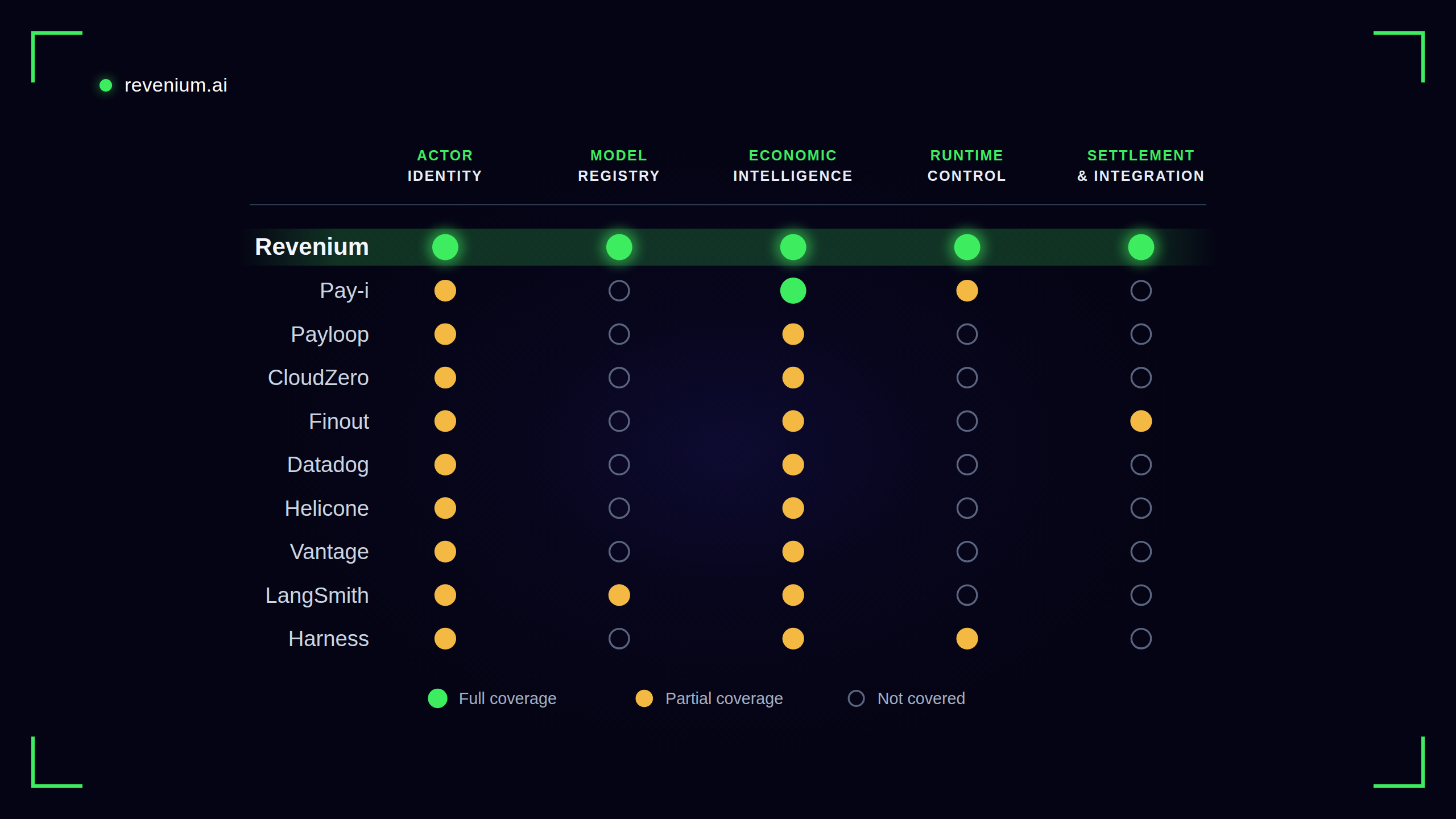
Full Comparison
Visibility and Control Are Not the Same Thing
Every platform on this list solves a real problem. But looking across all twelve, most of them are built to tell you what your AI has already spent, just at different levels of granularity and speed.
That means the answers typically arrive too late. AI agents don't operate on human timescales. They commit spend in milliseconds, around the clock, without approval. Visibility will tell you what happened after the fact, but it won’t stop low-ROI spend before it hits your budget.
If you need visibility into what your AI is spending, several platforms here will serve you well. If you need to decide, in real time, whether it should be spending at all, the list gets much shorter. Revenium is the only platform here that can evaluate an agent action before it runs, stop it if it isn't worth the cost, and record what happened in the same financial systems the rest of the business already uses.
See what your AI agents are really costing. Sign up for free.