
You Know What AI Costs. You Don't Know If It's Working.
Today, we are releasing AI Outcomes, a new capability within Revenium that links every AI agent execution to its business result and calculates ROI at the workflow level.
AI Outcomes is the second release in Revenium's AI Economic Control System, following Tool Registry earlier this year. Tool Registry answers what AI spent. AI Outcomes answers the question of whether that spending was worth the cost.
Why Cost Visibility Alone Isn't Enough
Tool Registry gave teams a full-stack view of AI spend, covering tokens, tool calls, external APIs, and human review steps, all attributed to the agent decision path that triggered them.
That was a necessary first step. But cost visibility without outcome visibility is still an incomplete picture.
Knowing that a loan processing workflow spent $2.95 per job tells you nothing about whether that job produced an approval, an escalation, or a dead end. Without outcome data attached to the same trace, cost per conversion is a guess, autonomy rates are meaningless, and any ROI claim you take to finance is built on inference rather than measurement.
That's the gap AI Outcomes was built to close.
What AI Outcomes Is
AI Outcomes introduces a shared unit of measurement called an outcome: a logical grouping that represents a business unit of work performed by AI, whether by a single agent handling a support ticket or a coordinated multi-agent pipeline processing a financial application.
Every operation within that workflow, including traces, tool calls, and human review steps, shares a common outcome identifier so costs and results can be read together.
When the workflow completes, a business result is attached. That result can be:
- CONVERTED - the workflow produced the intended business output
- ESCALATED - the workflow required human intervention
- DEFLECTED - the workflow resolved without escalation
- CUSTOM - any outcome definition your business requires
This creates a direct line between execution cost and measurable business result, something neither observability tools nor token dashboards can produce, because neither holds both sides of the ledger in one place.
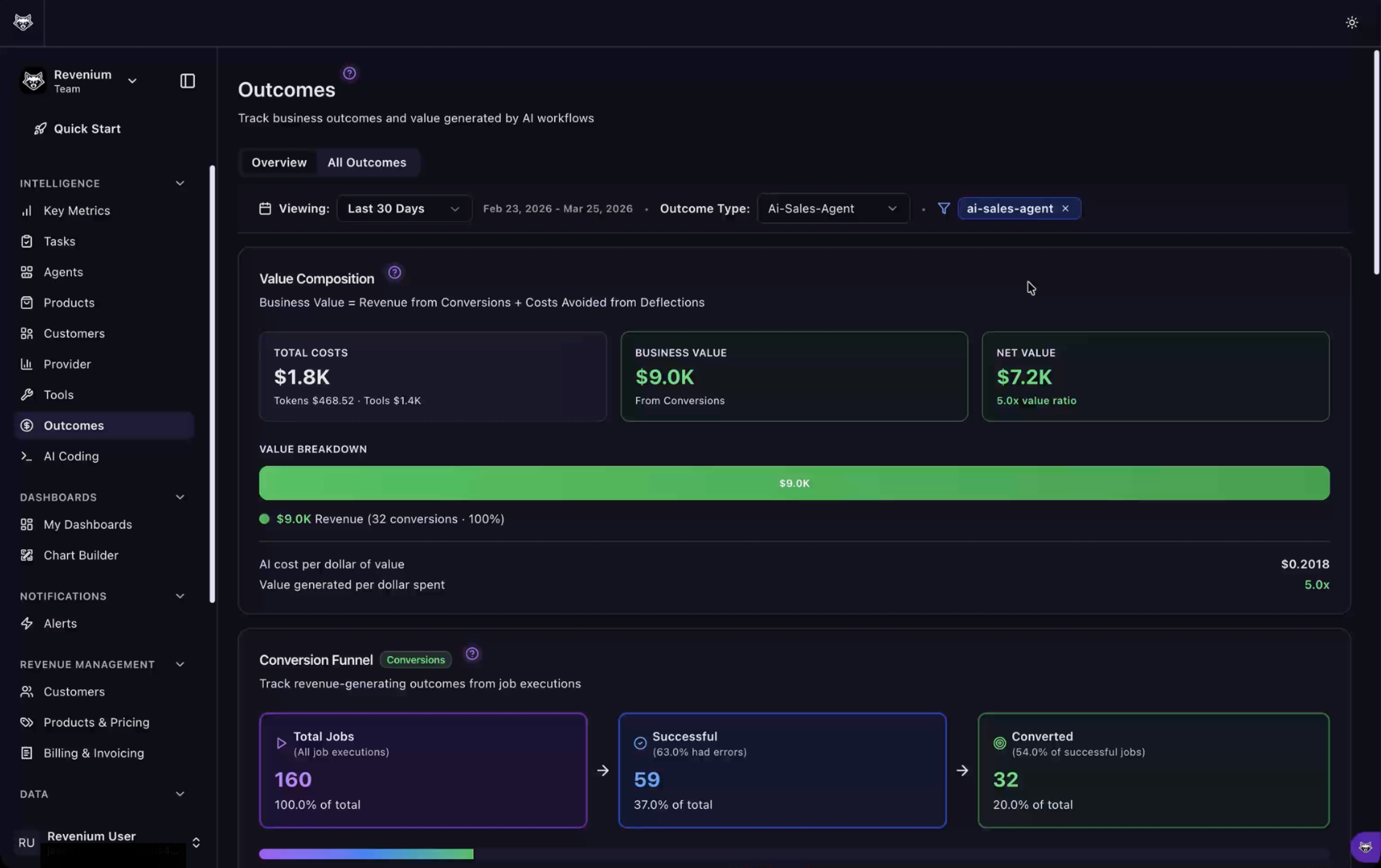
Here’s what that looks like in the product when costs and outcomes share the same unit of measurement.
What This Looks Like in Practice
Take a loan processing workflow running 1,000 jobs. With AI Outcomes, you can see:
- Total AI cost: $2,950
- Approvals produced: 780
- Loan value generated: $390,000
- Cost per conversion: $3.78
- ROI: 13,000%+
This is the exact kind of workflow-level value vs. cost view you need to defend ROI with real numbers.
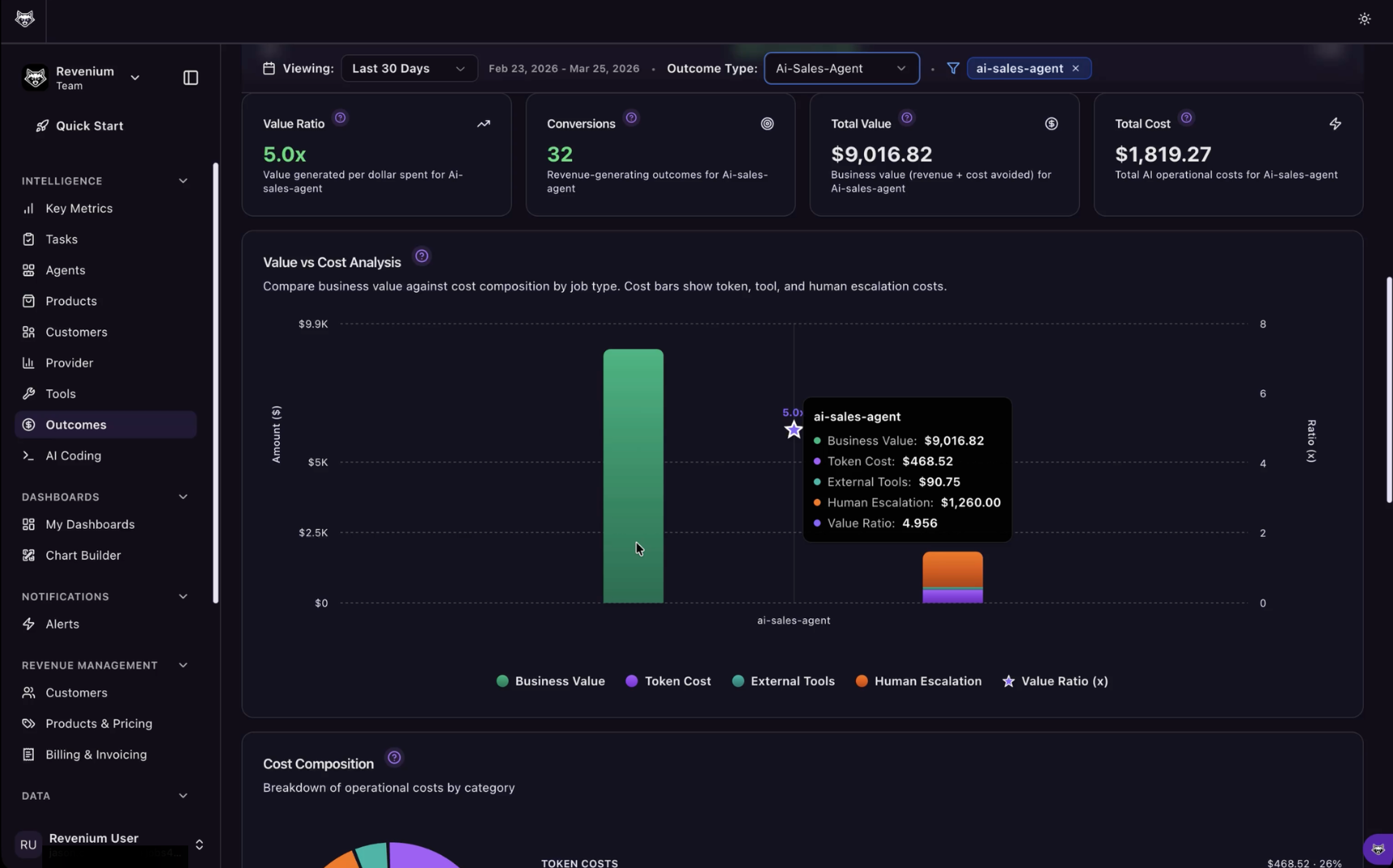
That calculation comes directly from trace data tied to real business results. It is the kind of proof that turns an AI pilot into a program you can scale and defend.
Without AI Outcomes, those two data sets sit in separate systems with no common unit connecting them. Engineering sees the operational side. Finance sees the business side. Neither side can answer the question the business is actually asking.
How the Two-Tier Outcome Model Works
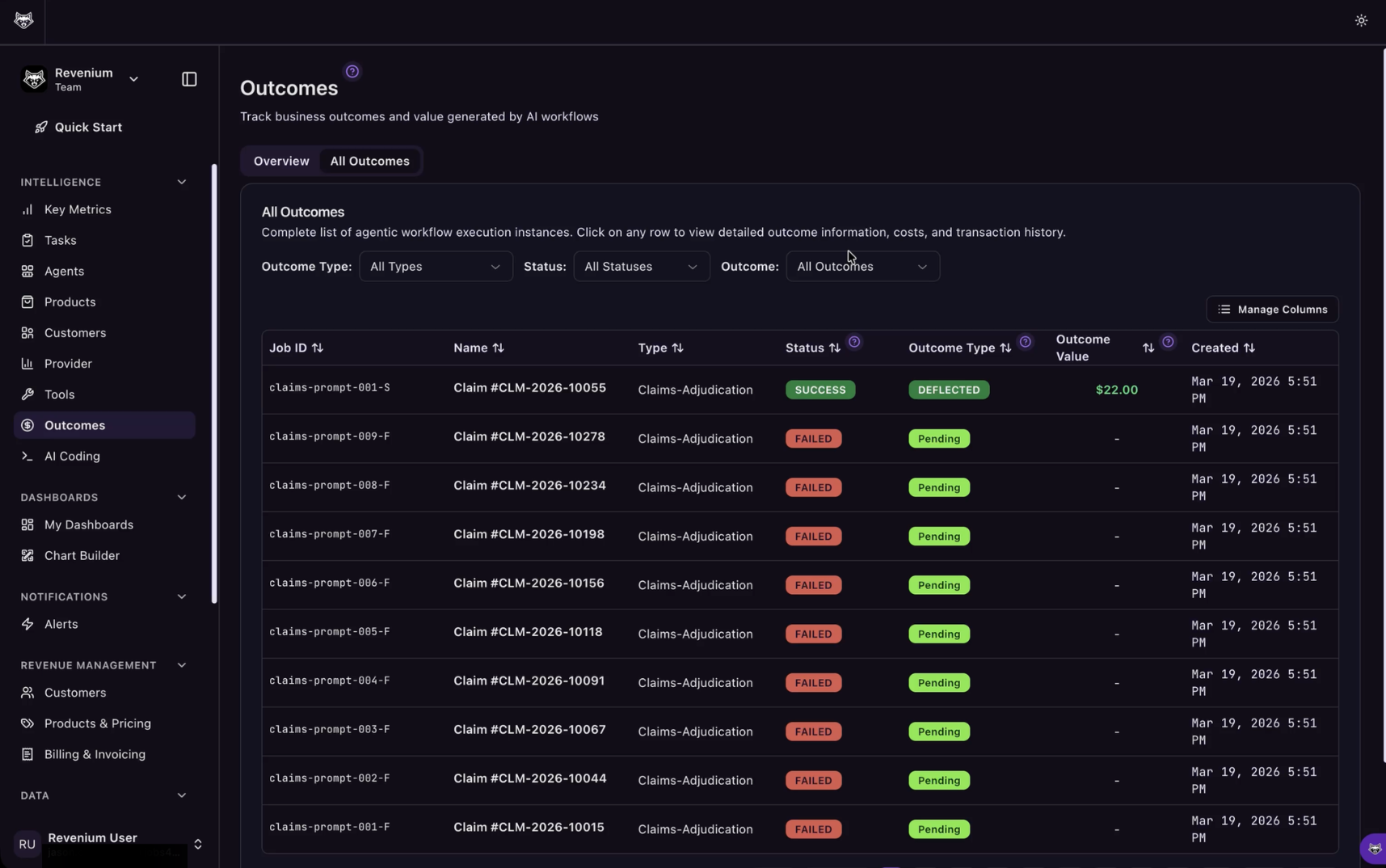
AI Outcomes deliberately separates execution status from business outcomes.
If you’ve ever had a workflow “succeed” technically but still fail to produce a business result, this distinction will feel familiar.
Execution status — SUCCESS, FAILED, or CANCELLED — is captured at the time of completion. This is the technical result.
Business outcome — CONVERTED, ESCALATED, DEFLECTED, or CUSTOM — can be reported at completion or attached after the fact. This matters because many workflows don't produce a downstream result immediately. A loan application approved today may be funded in 72 hours. A support ticket resolved now may generate a satisfaction score tomorrow. AI Outcomes accommodates that lag without losing the attribution.
Human review steps are tracked as cost events within the same job trace, consistent with how Tool Registry handles human-in-the-loop work. Over time, that data shows how the mix of AI and human effort is shifting, where review is still required, and whether automation is actually reducing cost per outcome or just displacing it.
Why AI Outcomes Exists
AI observability tools track latency, errors, and token counts. They tell you whether an agent ran, not whether it worked. Business intelligence tools track conversions and revenue, but have no visibility into what the AI stack spent to produce them.
The two systems don't share a unit of measurement, so connecting them requires manual work that most teams don't have time for, and most results that emerge from it are directional at best.
AI Outcomes sits at that connection point. It links every execution to its result across the full workflow and holds both in the same system of record. That makes it useful for both engineering and finance because it gives both sides the same number to work with.
Get Started with AI Outcomes
AI Outcomes is available today across all Revenium plans. Sign up for free to get started, or visit revenium.ai to learn more.