

AI is one of the fastest-growing line items in enterprise software budgets, and platform teams now have to defend the number. Ask them how they manage AI spend and the most common answer is, "we route to the cheapest provider." That settles unit price and nothing else, and finance has stopped accepting it.
Teams stand up a model router (OpenRouter, OmniRoute, LiteLLM's router) and call it their AI cost strategy. Adopting a router is the right move, but it settles only one layer of the stack. A router optimizes which model serves a request and at what unit price. It cannot tell us who the request was for, which business process it belonged to, whether the work was worth what it cost, or whether it should have run at all.
Three layers, three jobs
Every production AI setup has (or should have) three layers, each owning a different decision.
Routing layer. Decides which model or provider handles each request. OpenRouter, OmniRoute, LiteLLM's router. Budget object is an API key or workspace member. Metric is USD spend. Blind to customer, feature, job, skill, tool, outcome, and margin. That is what a router is for. Adopt it.
Gateway layer. Decides whether traffic may leave. F5 AI Gateway, Zscaler, the LiteLLM proxy, MCP gateways. Blind to business context and value delivered. Also necessary. Adopt it.
Economic Control System. Binds every AI transaction to who caused it and what it was worth. Decides whether the spend is justified. Enforces in-process, before the provider call. The missing layer for most teams, and where Revenium operates. We instrument it from either direction: plugins for the routers and gateways you already run, and SDKs inside the applications and agents themselves. The two are not either-or. Run both and the backend deduplicates the overlap, so a router plugin buys coverage on day one without re-plumbing anything, while client-side SDKs fill in the context a proxy can never see.
These layers are additive, not competitive. What follows is what the top layer does that the two below it cannot.
The four structural limits of a router
Once you look at a router as a component instead of a strategy, four limits show up.
1. Coverage. The router sees only what it carries, and not all of that.
Two gaps compound.
Traffic that never transits the router. Seat-based assistant subscriptions, native Bedrock and Vertex calls, agent tool and MCP invocations, teams holding their own provider keys. For most enterprises we work with, this is a meaningful share of monthly spend, and it grows as more work shifts into IDE assistants and agent frameworks.
Context the router cannot see on traffic it does carry. A proxy sees tokens, cost, and cache counts. It never sees which session, which skill, which development activity, or, absent per-user keys, which user. That context lives in the client and cannot be reconstructed downstream. A large financial-services firm running an LLM gateway told us they prefer client-side telemetry for exactly this reason.
2. Unit of accounting. Budgets attach to credentials, not business objects.
Router budgets attach to an API key or a workspace member. You cannot express "cap the returns-triage agent at $4K a day," "alert when this customer's workflow goes margin-negative," or "limit Opus spend per organization."
Teams sometimes work around this by minting a project-scoped key for every new agent or product. That creates a credential taxonomy someone maintains forever, and it collapses the moment two products share a service or one agent serves many customers. Chargeback built on keys is chargeback built on sand.
3. Enforcement semantics. A credential-scoped dollar cap is context-free.
A hard 402 when a key's USD total crosses a static line is one metric on one object, with no notion of what any request was worth. A $150 call that saves a $47K account and a $150 routine lookup look identical to the router. The cap kills whichever arrives after the threshold. No scoping by customer, no token or error-count rules, no way to trial a limit against production traffic before it starts failing requests.
4. Outcome measurement. Routing optimizes a proxy, not the goal.
Adaptive routing scores throughput, tool-call telemetry, and benchmarks. Good engineering signals, none of them a business outcome. A cheaper model that fails twice costs more than the expensive one that got it right the first time, and the router books the cheap failure as a win.
None of these limits is a missing feature. Routers ship real governance, and OpenRouter's Workspaces Guardrails are one implementation. But every control hangs off a credential, and a credential describes only the traffic it carried. Scope problem, not a quality problem.
Which layer answers the question
To pick a tool, ask which layer answers the question at hand. The first two have an answer at both layers, and the two answers are not the same size. The rest have only one.

Where both layers answer, they answer at different widths. The router settles the question inside the traffic it brokers. The Control System settles it across the whole bill.
Budget enforcement, side by side
We're often asked how Revenium Cost Controls differ from what routers already ship. Same axis, different reach.
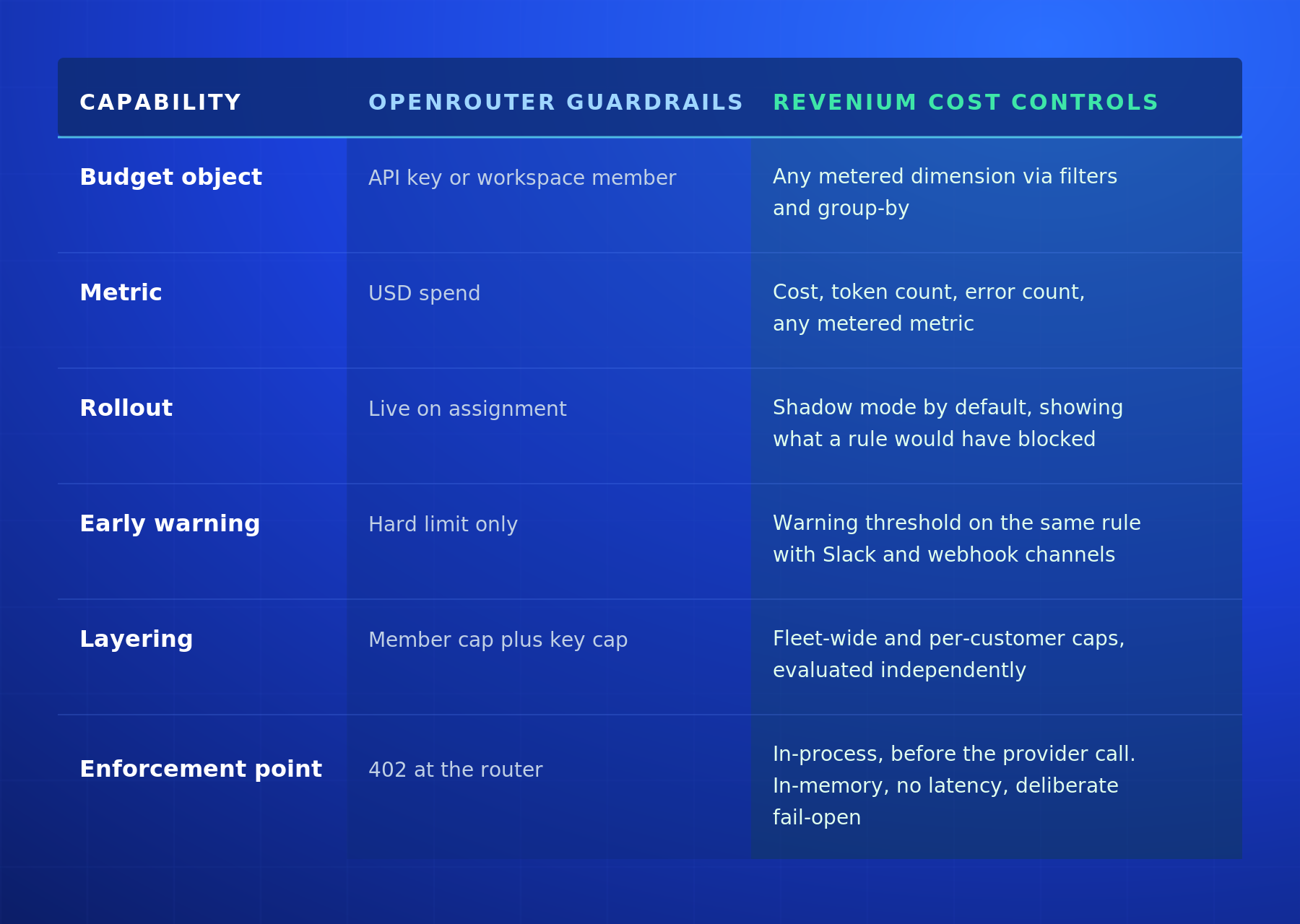
Governance gated by a router vendor's roadmap sits behind that vendor's incentives, and their margin comes from brokered tokens. Our SDKs are open source at github.com/revenium. Enforcement runs in your process, stays readable and extensible, and evaluates a ruleset you define.
What a token pipe cannot see
Even if coverage were perfect, structure would still be missing. An agent's economics are not a token stream. They are skills that trigger the spend, tools that cost money without emitting a token, and patterns that only appear across thousands of transactions.
Skill-level economics. Coding-assistant spend attributed to individual skills. Cost per execution, adoption maps, correlation against shipped PRs.
Trigger provenance. Was this invocation user-initiated, assistant-proactive, or nested? Did an in-house workflow fire it, a vendor plugin, or an unclaimed third-party marketplace tool? By the time tokens reach a pipe, provenance is gone. Revenium's trigger and origin attribution keeps it.
Tool and MCP economics. Agent-to-tool traffic never transits an LLM pipe, so a router cannot see it in principle. Revenium's Tool Registry meters each tool invocation as a first-class priced event. True workflow cost equals LLM plus tools plus retrieval, in one record. As agents shift work from tokens to tools, the router's share of the visible bill shrinks.
Predictive intelligence. Adaptive thresholds against your own distribution: P75, P95, P99. Efficiency anomalies catch looping agents before the cost lands. Circular-pattern analysis names the loop, its occurrences, and the wasted spend. Revenium AI Insights turns the ledger into a ranked action list with monthly savings estimates.
A token pipe can only re-rank providers. A structured ledger tells us what to change and puts a dollar figure on the recovery.
From chargeback to agentic commerce
Attribution is only half of an economic system. The other half is rating. Revenium ships a product-and-pricing engine on the same metered ledger, so chargeback and monetization become configuration on data you already have. Composable pricing with tiers and metering elements. Charges on real consumption. Internal chargeback via free products, with no invoicing theater. Pricing changes as a form edit rather than a deploy.
That machinery matters more every quarter. x402 is a Linux Foundation open standard backed by AWS, Cloudflare, Stripe, and Vercel: HTTP-native payments (402 Payment Required, pay, retry), with tens of millions of transactions already flowing. Agents paying per request need a price, a meter, and a settlement record. A marketplace router is the buyer side of that market. The seller-side rating and settlement engine those payments presuppose is what runs today as chargeback and tomorrow as usage-based billing, on the same ledger.
The layer above the router
Routing makes each call cheaper. The Economic Control System above it decides whether the call should have happened, who owes for it, and whether it was worth the money.
That gap widens every quarter. As agents move work from tokens into tools, retrieval, and MCP calls, the share of the bill any router can see keeps shrinking, while the questions finance asks keep moving further from unit price. Pick the best router you can. Then put something above it that can answer them.
Ready to see the Economic Control System on your own workflows? Book a Revenium walkthrough, or spin up the open-source SDKs at github.com/revenium.